
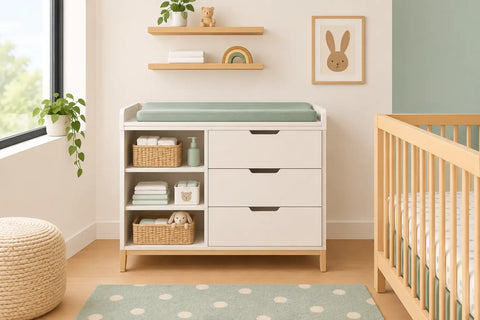
The nappy change may take only a few minutes, but it happens many times a day, often when you are tired and one hand is already occupied. Well-chosen changing tables turn that repeated routine into a calmer, more organised moment. They give baby a dedicated, comfortable place for care while keeping nappies, wipes and spare clothes close enough to reach without stepping away.
For many Singapore homes, the question is not simply whether a changing table looks good in the nursery. It is whether it is stable, easy to clean, proportioned for a compact room and useful long after the earliest months. The right choice should support real family life, not add another bulky item to work around.
What Makes a Changing Table Worth Having?
A changing table creates a consistent care station. Instead of changing baby on the bed, sofa or floor with supplies spread across the room, everything has a proper place. This can make the routine quicker and less stressful, particularly during overnight changes or when another child needs attention too.
Height matters more than many parents expect. Bending repeatedly over a low surface can become uncomfortable during the first weeks at home, when feeding, lifting and disrupted sleep are already demanding. A table designed for standing-height care can reduce unnecessary strain while helping you keep baby securely within arm's reach.
There is also a hygiene benefit. A wipe-clean changing surface is easier to maintain than repeatedly using soft furnishings, and a dedicated area helps keep changing essentials separate from everyday household items. That said, a changing table is a convenience, not a substitute for close supervision. Keep one hand on baby whenever they are on an elevated surface, and never turn away to retrieve an item.
Safety Comes Before Storage and Style
A beautifully styled nursery should never ask parents to compromise on stability. Start with the structure: the table should feel solid on the floor, without rocking, wobbling or shifting when you press gently on its sides. Check the manufacturer's stated weight and age guidance, then use the product only within those limits.
Raised sides around the changing area can provide an added physical boundary, but they do not make unattended changing safe. Babies can move unexpectedly, including much earlier than parents anticipate. Prepare everything before placing baby on the surface - a clean nappy, wipes, cream, muslin cloth and a change of clothes - so there is no reason to reach across the room.
Look for practical safety details
The most reassuring changing tables combine a stable base with smooth, carefully finished surfaces. Avoid sharp exposed edges, protruding hardware and gaps where little fingers could be caught. If the table includes drawers, ensure they open smoothly and are not so heavily loaded that the unit could become front-heavy.
For homes with older siblings or curious pets, consider where the station will sit. It should be away from windows, curtain cords, shelves holding heavy objects, heaters and areas of frequent foot traffic. If a wall-fixing kit is provided for a storage unit or changing station, follow the installation instructions carefully.
Materials deserve the same attention. Parents often prefer durable, non-toxic finishes that are suitable for nursery use and easy to wipe down. A quality changing mat should have a supportive feel, a non-slip base where applicable and a surface that can be cleaned promptly after spills. Premium-looking furniture is most valuable when it can handle everyday mess with confidence.
Choose the Right Type for Your Space
The best changing table depends on your room layout, storage needs and how long you want the furniture to serve your family. A compact nursery may benefit from a changing top fitted to an existing dresser, while a larger room may have space for a complete changing station with open shelves or drawers.
Dedicated changing stations
A dedicated changing station is built around the task itself. It usually offers a defined changing surface and nearby storage, making it easy to organise nappies, wipes and creams in the order you use them. This is an excellent choice for parents who want a clear daily-care zone from day one.
The trade-off is footprint. Before ordering, measure not only the wall space but also the room needed to stand comfortably in front of the unit and open any drawers. In a smaller flat, a narrow design with vertical storage may work better than a wide model.
Dresser-top changing units
A changing attachment or mat placed on a sturdy dresser can be a smart long-term solution. Once your child no longer needs a changing surface, the dresser remains useful for clothing, toys, books or bedding. This approach suits parents who value furniture that adapts as the nursery evolves.
Check that the top surface is suitable for the changing mat or attachment you choose. It should be deep enough to support it securely, and the dresser itself should be stable and appropriately anchored where required. Do not improvise with a surface that is too narrow or a mat that overhangs the edge.
Mobile changing trolleys
A trolley can help in homes where care happens in more than one room. It can hold essentials beside the cot at night, move to the living area during the day and later become storage for bath items or crafts. Choose a model with dependable wheels and brakes, and always lock it before use.
A trolley is convenient, but it usually has less enclosed storage than a full station. If you prefer a visually tidy nursery, use baskets or organisers to prevent small items from becoming cluttered.
Plan Storage Around the Actual Nappy Change
The best storage is not necessarily the most storage. It is storage arranged around what you use most. Keep daily essentials at the easiest-to-reach level, with backup packs and out-of-season clothing lower down or elsewhere in the room.
An organised changing table often needs only a few well-defined zones: nappies and wipes together, creams and grooming items in a separate caddy, spare clothing folded within reach, and a lidded bin nearby. If you use open shelving, small baskets can keep supplies neat while making it simple to see when stock is running low.
Be cautious with items stored above the changing surface. Heavy containers, glass bottles and framed décor do not belong on an overhead shelf where they could fall. A nursery can still feel warm and personal with soft colours, artwork positioned safely out of reach and thoughtfully chosen storage pieces.
Measure Before You Buy
Parents often focus on the width of a changing table, but depth and clearance are equally important. Measure the intended position, nearby doors, cot access and drawer opening space. If the station will sit beside a wardrobe, leave enough room to use both pieces without squeezing through a narrow gap while carrying baby.
Consider your own height as well. There is no single perfect changing height, but the surface should allow you to change baby without constantly hunching your shoulders. If possible, see the proportions in person at a showroom or compare the listed dimensions carefully against a surface at home.
Think ahead to where the furniture will go after the changing stage. A unit that becomes a dresser, bookcase or toy-storage cabinet can offer better value than a piece with only one short-term purpose. This does not mean every family needs a convertible option. If space is limited and you prefer a simple, compact station for the first year, that can be the more practical decision.
Keep the Changing Area Clean and Calm
A calm changing station is easier to maintain when its materials work with your routine. Wipe the mat after each messy change using a baby-safe cleaning method recommended for the surface, and deal with spills promptly rather than allowing moisture to sit in seams or joins. Wash removable covers according to their care label and inspect the mat regularly for cracks, peeling or worn edges.
Keep fragrance-heavy products to a minimum if baby has sensitive skin, and avoid overfilling the tabletop with lotions and accessories. Clear space is useful space. It gives you room to focus on baby and makes daily cleaning far less of a chore.
A changing table does not need to dominate the nursery to make a meaningful difference. Choose one that feels secure under hand, suits your home and keeps the essentials ready for the next change. With a thoughtful design and dependable materials, this small station can bring a little more order to the busiest moments of early parenthood.