
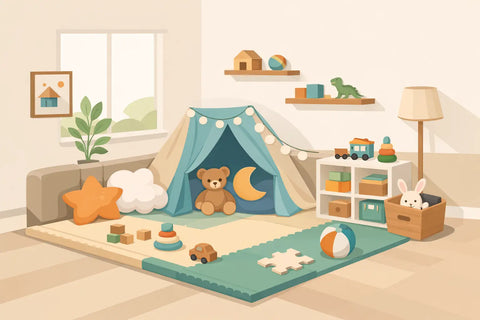
The moment your baby starts rolling with purpose or crawling towards the least child-friendly part of the room, the idea of a dedicated play space stops feeling optional. If you are wondering how to build safe play corner areas at home, the best approach is not simply adding toys to one side of the room. It is about creating a space that protects movement, supports development and still feels calm and well considered within your home.
For many families, especially in Singapore where space often needs to work harder, the play corner sits in the living room, nursery or master bedroom rather than in a separate playroom. That makes safety and design equally important. A good play corner should feel inviting for your child, practical for daily routines and easy for parents to maintain.
How to build a safe play corner without wasting space
Start by choosing the right location. The safest play corner is usually somewhere visible, away from cooking areas, sharp furniture edges, floor-standing lamps and heavy décor. Parents often do best with a corner that allows supervision while they are folding laundry, preparing a bottle or taking a quick seat nearby. Convenience matters because a play area only works if it is used every day.
Natural light is helpful, but direct sun on the floor can make surfaces too warm and uncomfortable, particularly for babies spending time on their tummy or learning to sit. If the chosen corner is beside a window, check that blinds, curtain cords and low window handles are fully out of reach. This is one of those details that can be missed when the space looks tidy but has not been assessed from a baby’s eye level.
The size of the corner depends on your child’s stage. A young infant needs soft, hygienic floor space for tummy time and stretching. A crawler needs room to pivot, push up and move. A toddler needs boundaries, safe surfaces and enough space to move without constantly colliding with furniture. You do not need a large footprint, but you do need clear space that is genuinely usable.
Start from the floor, not the toys
Parents often shop for bookshelves, baskets and activity items first, but the floor is the true foundation of a safe play corner. Babies spend most of their active time close to the ground, so flooring affects comfort, hygiene and shock absorption every single day.
A high-density foam play mat is often the strongest starting point because it creates a softer surface over tile or timber flooring while still offering enough support for crawling and early standing. Thickness matters here. A very thin mat may look neat but will not provide the same cushioning during tumbles. Surface texture matters too. Anti-slip finishes help reduce sliding, particularly when little feet start pulling up and cruising.
Material quality should not be treated as a minor feature. Parents are right to prioritise non-toxic, easy-clean and baby-safe materials because babies touch, crawl and rest face-down on these surfaces. In a humid home environment, easy maintenance is just as important as comfort. A mat that wipes clean quickly will save time and make the corner more usable day after day.
If you want a more enclosed layout, a compatible playpen and mat system can make a real difference. The practical advantage is not just containment. A well-fitted combination helps avoid awkward gaps between the mat and frame where hands, feet or toys can get caught. This is especially useful for active babies who move constantly and for parents who want a cleaner, more secure setup.
Create boundaries that feel safe, not restrictive
A play corner should offer freedom within a controlled environment. That means your child should be able to explore without you needing to say no every thirty seconds. The easiest way to achieve that is to reduce hazards inside the space rather than relying on constant correction.
If the corner sits near standard household furniture, secure anything that could tip. Low storage units, side tables and shelving should be stable and anchored where necessary. Avoid placing decorative objects, framed photos, candles or charging cables within reach, even if your baby is not mobile yet. Mobility comes quickly, and play spaces should be prepared slightly ahead of development, not after the first near miss.
Soft edge protection can help if there are unavoidable corners nearby, but it should not become an excuse to keep unsuitable furniture too close. There is a difference between childproofing and compromise. Where possible, keep the perimeter simple and clear.
For some homes, a playpen-style boundary is the best choice, especially when older siblings, pets or open-plan layouts create extra unpredictability. In smaller homes, this can also help define the play zone visually, making it easier for everyone to understand where toys belong and where baby-safe space begins.
Choose furniture that earns its place
The most effective play corners are not crowded. They include only what supports safe use and easier routines. A small amount of well-chosen furniture nearly always works better than a roomful of pieces scaled down for children.
Storage should be low, stable and easy for adults to access without bending awkwardly over the play area. Open baskets or lidded containers can work well, but be mindful of hard lids, pinch points and overfilled bins. Too many toys in one place create visual clutter for parents and overstimulation for children.
A simple shelf or compact organiser can be enough if it keeps essentials tidy. Rotating toys rather than displaying everything at once is often the smarter move. This keeps the corner calmer and makes cleaning easier. It also encourages more focused play, which many parents notice quickly once the environment becomes less busy.
Any furniture placed inside the corner should have rounded edges, wipe-clean surfaces and a stable build. Lightweight decorative pieces may suit an adult living room, but they are rarely the best choice in a baby zone. This is where premium nursery furniture tends to justify itself. Better materials, stronger construction and safety-focused design usually pay off over time.
Keep hygiene simple and realistic
A play corner does not need to look clinical, but it should be easy to keep clean. Babies spend an astonishing amount of time on the floor, then put their hands straight into their mouths. That makes washable surfaces and fuss-free upkeep central to safety, not just convenience.
When deciding how to build safe play corner spaces, think about what will happen on an ordinary Tuesday rather than in a styled showroom. There will be milk drips, snack crumbs, nappy leaks and the occasional mystery stickiness. Mats, toy bins and surrounding surfaces should all clean without special treatment or complicated routines.
Try not to fill the area with fabrics that trap dust or pieces that need frequent laundering unless they serve a real purpose. One or two washable soft items are fine. An entire collection of cushions, fabric canopies and plush décor may look charming, but it often adds maintenance without adding function.
Make it look like part of your home
Parents should not have to choose between a safe play area and a home that feels pulled together. A well-designed play corner can look calm, modern and intentional. Neutral tones, soft textures and coordinated storage usually help the space settle naturally into a nursery or shared family area.
This is where design-conscious baby products stand out. Scandinavian-inspired styling, clean lines and muted colours can make practical essentials feel far more at home in adult spaces. That matters because a play corner is not just for your child. It is something the whole household lives with every day.
Still, appearance should follow function. If a beautiful item is difficult to clean, unstable or made from questionable materials, it is not the right fit. The best-looking play spaces are usually the ones built on good decisions rather than decorative extras.
Safety checks to revisit as your child grows
A play corner is never fully finished because your child keeps changing. What works for a three-month-old can be completely unsuitable for a one-year-old. That is why regular review matters.
Every few weeks, get down to floor level and reassess the space. Look for newly reachable cords, heavier toys that could fall, furniture your child is now trying to climb and sections of the mat that may be shifting with use. This quick check often reveals issues before they become accidents.
It also helps to watch how your child actually uses the space. Some babies stay centred on the mat, while others test every boundary immediately. Some toddlers love climbing, while others focus on sensory play. Your ideal setup depends partly on those habits, so flexibility matters.
For parents who want a safer and more polished start, specialist baby brands such as RaaB Family can simplify the process with coordinated play mats, playpens and nursery essentials designed to work together. That compatibility can remove much of the guesswork, especially when space, safety and style all need to align.
The best play corner is not the most elaborate one. It is the one that lets your child move, explore and grow with confidence while giving you peace of mind every time you set them down to play.