
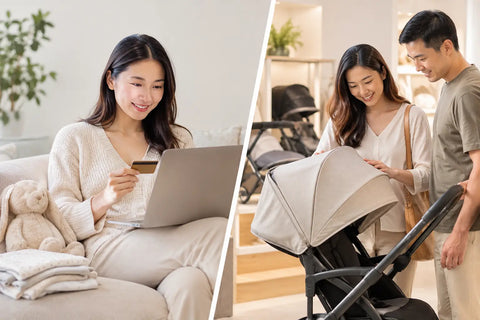
A play mat can look perfectly proportioned on a product page, then feel very different once it is beside your sofa, dining table and little one’s favourite basket of books. That is where online versus showroom shopping becomes a practical decision, rather than simply a matter of preference. For parents choosing baby and toddler essentials, both routes can be useful. The right one depends on what you need to confirm before bringing an item into everyday family life.
For some purchases, detailed online information and a tape measure are all you need. For others, seeing the texture, scale or fold of a product in person can make the decision feel clearer. A considered approach lets you use each shopping experience for what it does best.
Online versus showroom shopping: what changes?
Online shopping gives you time. You can compare dimensions after bedtime, revisit product details without being rushed and consider how an item fits with the room you already have. This is particularly helpful when planning a nursery, refreshing a play corner or working around a busy family schedule.
A showroom gives you a sense of the product beyond the screen. You can see how a colour sits in natural light, assess whether the finish suits your home and understand the physical presence of a larger item. When you are deciding between two similar options, that experience can be valuable.
Neither option is automatically better. A simple, smaller item with clear measurements may be easy to choose online. A playpen, play mat or nursery furniture piece that will shape the layout of your home may be worth viewing first, especially if you are unsure about size, access or how it will work with your daily routine.
When online shopping makes the most sense
Shopping online is ideal when you already know the dimensions, features and style you need. It also works well for parents who want to make decisions gradually, perhaps while comparing a few products across different rooms of the home.
You can check the details at your own pace
Good product information should help you move beyond photographs. Look for clear dimensions, material descriptions, care guidance, setup information and notes on what is included. This lets you compare like with like and avoid making assumptions based on images alone.
Before adding anything to your basket, measure the intended space. For a play mat, consider not only the open floor area but also space for adults to sit nearby, walk through the room and open cupboard doors. For a playpen or nursery furniture, check wall lengths, windows, drawers and the route from your front door to the room.
In Singapore homes, lift access, corridor width and room layout can be just as relevant as the product’s footprint. Measuring early makes delivery day more straightforward and helps prevent a carefully chosen piece from making a room feel crowded.
It is easier to compare the full cost and practicalities
Online pages can help you review delivery arrangements, lead times, assembly requirements and care instructions alongside the product itself. This matters because the most suitable item is not always the one with the most features. It is the one that fits the way your family lives.
Think about what happens after the first week. Will the surface be easy to wipe after meals, crafts or everyday spills? Can you move the item when you need to clean? Does its design allow the room to stay calm and organised when guests arrive or the day gets busy? These are the details that often matter most over time.
You can involve your household without another trip
Online browsing makes it simple to share options with a partner or family member, compare measurements against your floor plan and return to the same information later. It is also useful if you have a clear visual direction, such as soft neutrals, natural textures or a modern, uncluttered look.
That said, do not rely on colour alone when shopping from a screen. Device settings and lighting can affect how shades appear. Focus first on the confirmed specifications and whether the product will work functionally in the space.
What a showroom helps you understand
Some choices are easier once you can stand beside them. A showroom visit does not replace reading the product details, but it can answer the questions that are difficult to resolve from images.
Scale is easier to judge in person
Parents often know the dimensions of a product but find it hard to picture them. In a showroom, you can observe how a play mat anchors a space, how a playpen sits within a room and whether a furniture piece feels visually light or substantial.
This can be especially useful if you are furnishing a compact nursery or a shared living area. You may realise that a slightly different size leaves more comfortable circulation space, or that a tone you assumed was too warm works beautifully with your existing flooring.
Touch can answer everyday-care questions
Seeing a product in person gives you a closer sense of its texture, finish and construction. You can assess whether it feels aligned with the level of comfort and ease of care you want for your home. If a product needs setup, a showroom may also help you understand how the parts come together and what the finished arrangement looks like.
Use the visit to ask focused questions. Ask which measurements are most important to plan for, how to care for the surface according to the product guidance and what to expect at delivery. Clear questions lead to clearer decisions.
It can reduce uncertainty for larger purchases
For a larger or longer-term item, confidence often comes from seeing it first. This is not about finding a perfect product. Every home has different constraints, from storage needs to the shape of a living room. It is about choosing an option whose compromises you understand and are comfortable with.
A physical visit can also be reassuring if you are deciding between finishes or layouts. RaaB Family showrooms are designed to help parents view selected products in a real-life context and ask practical questions before they buy.
A sensible way to use both
For many families, the most useful answer to online versus showroom shopping is not either-or. Start online to narrow your choices. Read the specifications, save the options that suit your space and write down the questions that remain. Then visit a showroom if you need to check the scale, colour or finish before deciding.
If visiting is not practical, take the same disciplined approach at home. Measure twice, review the setup and care information, and think through the route the product will take into your home. Avoid choosing solely because an item looks good in a styled photograph. A well-considered purchase should look at home in your own space, not just on a screen.
It helps to keep your decision centred on four everyday considerations: the available space, the materials and care requirements, the setup involved, and the delivery arrangements. These are more useful than chasing trends or trying to predict every future need.
Questions worth asking before you buy
Whether you shop online or in person, a few practical questions can bring the decision into focus. Will this fit the room with enough space to use it comfortably? Have I checked the product dimensions rather than estimated from photographs? Do I understand how to clean and maintain it? Is the delivery and setup plan realistic for my home?
Also consider how the item will work across an ordinary week. A beautiful nursery piece should not make daily storage harder. A play area should feel easy to reset at the end of the day. The best choice is often the one that supports your routines quietly, without demanding extra effort from already busy parents.
If you are still deciding, give yourself permission to pause. Measure the space again, look at the product information one more time, or arrange a visit if seeing it in person would settle the question. A thoughtful purchase begins with a clear picture of the life it will become part of.