
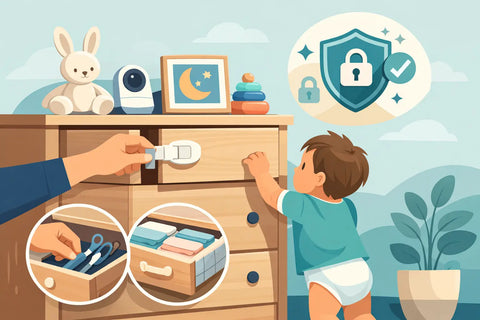
A nursery can look perfectly calm until a curious toddler opens the lowest drawer, uses it as a step and turns a chest of drawers into a climbing frame. Learning how to secure nursery drawers is one of those small jobs that can make a meaningful difference to everyday safety, especially once your child begins pulling up, cruising and exploring independently.
Drawer furniture is useful from day one for nappies, clothing and changing essentials. Yet any freestanding unit can tip if weight shifts forward. The safest approach combines proper wall anchoring, sensible drawer storage and regular checks as your child grows.
Why nursery drawers can become a tipping risk
A chest of drawers may feel solid when it is standing empty against a wall. The risk changes when one or more drawers are extended. The weight moves forwards, the unit becomes less stable and a child can gain a foothold surprisingly quickly.
Toddlers do not need to be particularly heavy for this to happen. They may pull on a handle to stand, climb into an open drawer to reach something, or lean their body weight on the furniture while playing. A changing mat placed on top can also encourage adults to store frequently used items in the upper drawers, which makes thoughtful organisation even more important.
This is not a reason to avoid nursery drawers altogether. It is a reason to treat tall or heavy furniture as part of your childproofing plan, just as you would cover electrical sockets or secure a stair gate.
How to secure nursery drawers to the wall
The most reliable way to prevent tipping is to attach the unit to the wall using anti-tip hardware designed for furniture. Many quality nursery drawers include wall-fixing brackets or straps, but check the box and assembly instructions rather than assuming they are included.
Start by positioning the drawers where you want them to remain. Leave enough room to open drawers fully without catching a cot, door or other furniture, but keep the unit close enough to the wall that the supplied fixing can work as intended. Furniture should sit level on the floor before you attach anything.
Choose fixings for your wall type
This is the detail that matters most. A fixing that is secure in solid concrete or brick may not be suitable for plasterboard, partition walls or walls with concealed services. The hardware supplied with furniture may be appropriate for common wall types, but it is not always universal.
If you are unsure what is behind the wall, ask a qualified installer, particularly in a rented flat or a newer home with lightweight internal partitions. They can identify a stud where needed, select the correct anchors and avoid drilling into electrical wiring or pipework. A secure furniture strap is only as strong as the point where it is fixed.
Use both attachment points where the furniture design provides two. Fit the straps or brackets taut enough to prevent forward movement, while following the manufacturer’s guidance on any small clearance required behind the unit. Do not rely on the drawer unit simply resting against the skirting board.
Do not substitute adhesive strips for proper anchors
Heavy-duty adhesive products can be useful for lightweight accessories, but they are not a dependable replacement for mechanical wall fixings on a chest of drawers. Heat, humidity, dust and time can weaken adhesion. For a heavy nursery unit that may be pulled by a child, screws and wall-appropriate anchors are the safer choice.
If drilling is not permitted in your home, speak to your landlord or property manager before the nursery is set up. The conversation is worthwhile. A small, professionally repaired drill hole is generally a far better trade-off than leaving climbable furniture unsecured.
Make the drawers harder to climb and safer to open
Wall anchors address the major tipping hazard, but daily use still matters. A well-secured chest can be made even safer by reducing the temptation and opportunity to climb.
Keep heavier items in the lowest drawers. Bedding, towels and bulk packs of nappies can help lower the unit’s centre of gravity, while lighter clothing, muslins and small accessories belong higher up. Avoid storing heavy items in the top drawer, especially if your child could open it.
Where drawers are easy for a toddler to access, consider drawer latches. Internal child-safety latches can limit opening distance and help prevent little fingers from reaching medicines, creams, scissors or other unsuitable items. They are particularly useful if the drawers are used for more than baby clothes. However, latches do not replace wall anchoring: a child can still pull against a partly opened drawer.
Keep one drawer open at a time whenever possible. Adults often do this instinctively while dressing a baby, but older siblings and visiting children may not. Closing each drawer after use removes the most obvious climbing step and reduces the chance of trapped fingers.
Think carefully about placement and the changing area
A drawer unit used as a changing station needs additional attention. Place it on a stable, level surface, away from windows, curtain cords, shelves and anything a child might grab. Keep it clear of the cot so that an adventurous toddler cannot move between the two pieces of furniture.
If you use a changing mat on top, choose one that sits securely and does not slide. Keep daily essentials within your reach rather than on a high shelf, so you never need to step away while your baby is on the changing surface. Even with a changing station, one hand should stay with your baby at all times.
Avoid placing decorative objects, framed photographs, lamps or heavy storage baskets on top of the drawers. They can fall if the furniture is knocked or shaken. A clean, uncluttered top also makes wiping down the changing area easier, which is a practical benefit during busy nappy changes.
Check the furniture itself before and after installation
Safe fixing starts with a sound piece of furniture. Before using nursery drawers, inspect the carcass, drawer runners, handles, feet and back panel. Tighten loose screws during assembly and make sure each drawer slides without sticking or suddenly coming free.
Look for rounded edges, smoothly finished surfaces and durable, child-considerate materials when choosing nursery storage. Premium-quality construction is not only about how a room looks. Stable joinery, dependable runners and a finish that is easy to clean all support safer, easier daily use.
Once installed, test the drawers with care. Open a drawer, apply gentle forward pressure and check that the unit does not shift. You are not trying to recreate a child climbing on it, but you should feel confident that the furniture is firmly restrained. Recheck after moving house, redecorating, replacing flooring or rearranging the nursery.
Build a simple safety check into your routine
Nursery safety changes quickly because children change quickly. What was out of reach last month may suddenly be accessible after your child learns to stand. A brief monthly check is usually enough to catch loose straps, missing screws, overloaded drawers or newly reachable items.
Pay particular attention after family visits or playdates, when drawers may have been left open and furniture may have been moved slightly. If you notice a child repeatedly pulling at the drawers, treat it as a prompt to reassess the room rather than as a behaviour you can simply supervise away.
A well-planned nursery should feel comfortable, beautiful and easy to use, not filled with obstacles. Secure drawers let you keep the storage you need while giving your growing child a safer space to explore. Fit the right anchors, keep the layout practical and revisit the set-up as your little one becomes more mobile.