
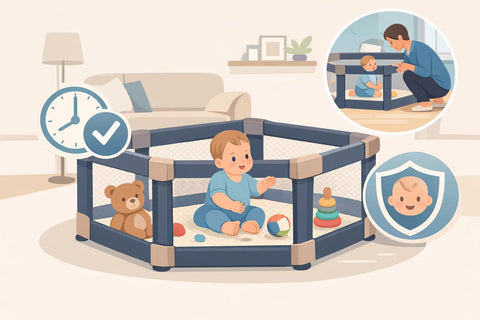
A baby who has just learnt to roll can cross a living-room floor far faster than expected. That is often the moment parents begin asking when to use baby playpen in their daily routine. A well-designed playpen gives your child a clearly defined place to move, explore and play while helping you manage the practical moments that cannot wait, from preparing a bottle to answering the door.
The right time is not determined by age alone. It depends on your child’s mobility, temperament and stage of development, as well as your home layout and how the playpen will be used. Most importantly, a playpen should support attentive supervision, not replace it.
When to use a baby playpen by stage
Before your baby is mobile
A playpen can be useful from the early months as a clean, contained floor-level area for short periods of awake play. This is particularly helpful for tummy time, reaching for sensory toys and simply having a calm space away from pets, dropped food or busy foot traffic.
At this stage, your baby will not need the boundaries in the same way an older child does. The real benefit is creating a hygienic, comfortable play zone that is ready when you need it. Choose a firm, supportive surface and keep the area simple. A few age-appropriate toys are enough; a crowded space can make it harder for a young baby to move freely.
A playpen is not automatically a sleep space. If your child falls asleep during play, follow the manufacturer’s instructions and your local safe-sleep guidance. Never assume that every playpen, mat or padded surface is suitable for unsupervised or routine sleep.
When rolling and crawling begin
For many families, this is when a baby playpen becomes genuinely invaluable. Once babies can roll, pivot or crawl, they are drawn towards low tables, power points, shelving and anything they can pull down. Even a thoroughly childproofed home has moments when you need an extra layer of protection.
Use the playpen for brief, supervised sessions while you prepare meals, fold laundry, take a shower or settle an older sibling. It can also offer a welcome boundary during visits, when bags, shoes and small objects may be within reach.
The aim is not to contain your child all day. Crawling and cruising are important for strength, coordination and confidence, so babies still need plenty of supervised time outside the playpen. Think of it as a safe base within a larger home environment, rather than the only place your child is allowed to play.
During cruising and early toddlerhood
As babies begin pulling themselves up, safety details matter even more. A sturdy playpen can create a secure area for standing, moving along the sides and practising balance, provided it is designed for that developmental stage and assembled correctly.
Some toddlers enjoy having a familiar little play space with books, soft toys and open-ended activities. Others quickly object to being enclosed, especially once they can walk confidently. If your child becomes frustrated, use shorter sessions and reserve the playpen for times when containment genuinely improves safety. A playpen should feel predictable and positive, not like a punishment.
The everyday moments a playpen helps most
A baby playpen earns its place when it solves a real household problem without compromising your child’s comfort. In compact homes, it can define a play area without requiring an entire room to be redesigned around baby gear. It also gives older children a clear visual cue that certain toys belong to the baby.
It is especially useful during the small transitions that make up a parent’s day: putting away groceries, making a quick meal, changing bedding, receiving a delivery or helping another child use the bathroom. These tasks are often only a few minutes long, but they are exactly when an active crawler can find trouble.
A playpen can also make playtime more manageable on hard flooring. Pairing it with a thick, high-density foam play mat provides a softer landing for sitting, rolling and early tumbles, while giving the space a more comfortable feel. For design-conscious families, a coordinated playpen-and-mat set can look considered in the living area rather than temporary or cluttered.
What makes a playpen safe enough to use
A playpen is only as safe as its design, setup and day-to-day use. Look beyond appearance and check the product information carefully. Quality materials, secure construction and independent safety testing should be central to your decision.
Before each use, make sure:
- the playpen is fully assembled, locked and placed on a level surface;
- there are no loose fittings, tears, sharp edges or damaged panels;
- the mat fits securely, with no gaps at the sides where little fingers or toys could become trapped;
- toys are appropriate for your child’s age and do not create a climbing aid;
- the playpen is positioned away from windows, blinds, heaters, cords and furniture your child could reach.
For a product used every day, easy-clean materials matter too. Babies explore with their hands and mouths, and snack time has a way of travelling. Non-toxic, durable surfaces that can be wiped down quickly make it easier to maintain a clean environment without turning every spill into a major task.
How long should your baby stay in a playpen?
There is no single perfect time limit. Your child’s age, energy level and need for movement all play a part. A content baby may happily play for a short stretch while you complete a task, while another may need to come out after only a few minutes.
Watch your child rather than the clock. If they are engaged, moving comfortably and playing safely, the playpen is doing its job. If they are upset, overtired or repeatedly trying to climb, it is time for a change of scene. Regular floor play outside the playpen, outdoor time and parent-led interaction remain essential parts of a balanced routine.
It also helps to avoid using the playpen only when you need to step away. Spend time sitting beside it, reading books or playing together inside the space. This builds a positive association, so your child recognises it as their own familiar area rather than a place they are put when you are busy.
Choosing a playpen that suits your home
The best choice balances safety, size and everyday practicality. Measure your intended space before buying, including room for adults to walk around it comfortably. A playpen that looks compact online can still dominate a smaller living room, while one that is too small may feel restrictive as your baby becomes more active.
Consider how it will look in the room where you spend the most time. Neutral colours, clean lines and Scandinavian-inspired styling can help a playpen sit naturally alongside modern furniture. However, good looks should never come ahead of secure panels, child-safe finishes and a stable base.
For parents building a complete play setup, RaaB Family offers coordinated playpen and play mat solutions designed to bring together comfort, safety and a polished home aesthetic. Choosing compatible pieces can remove the uncertainty of finding a mat that fits properly and performs well on your flooring.
A playpen is most useful when it gives you a little breathing room while giving your child a safe place to be curious. Set it up thoughtfully, use it for the moments it genuinely helps, and let it support the wider rhythm of play, connection and growing independence at home.